Marta Djourina & Andréa Vamos in Conversation with Curator Livia Klein, Luxembourg Art Week
You work in complete darkness. How do you know what you are making?
Working in complete darkness, I rely on bodily memory to guide my movements, developing choreographies of light that become colour drawings on photographic paper. I call it blind painting: the marks remain invisible until chemical development reveals the latent image. I’m fascinated by this delay, by the gap between the physical gesture and the moment its trace becomes visible. MD
Marta, your installation is also built in layers. What are you presenting?
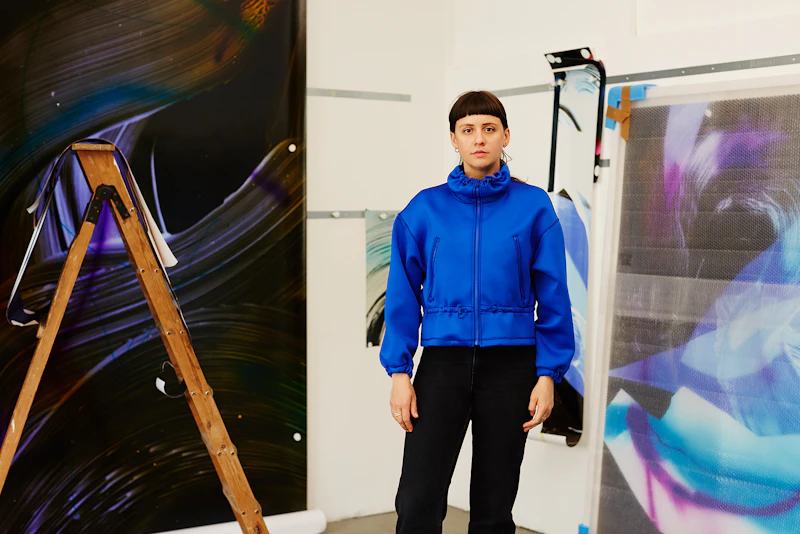
I am presenting States of Motion, a new installation centred on a large, unique photographic work made of three analogue pieces, each about 127 × 250 cm. The works are unique analogue exposures, produced directly on photosensitive paper, in complete darkness and without a camera. I move in front of the paper with lasers, self-built light tools and coloured filters. For Capsules, rather than presenting the three pieces as one flat image, I suspend them at different depths. The work comes apart and enters the architecture: its fragments overlap, disappear and realign as the passerby moves along the window.
You work in complete darkness. How do you know what you are making?
I orient myself through my body and memory, remembering where I have moved, where the light has already touched the surface and for how long. It is a bodily knowledge. Over fourteen years in the darkroom, I have developed what I like to call choreographies: movements with lights in my hands and on my body that turn into colour drawings on the paper. I sometimes call it blind painting. But unlike in painting, I don’t see the mark appear. The light produces a latent image that only becomes visible through chemical development. I find that delay fascinating. I find the gap between these two timelines interesting: the recorded trace only takes on a material appearance at a later point.
So the photograph records a trajectory rather than a representation.
Yes. I am not standing outside something and photographing it. My body becomes part of the photographic apparatus: it measures distance, directs light and determines duration. The photograph is not an image of my body, but evidence that a body has moved through that space. A trajectory tells us that someone has passed through without revealing who it was. The photograph becomes an archive of a performance that no longer exists. The body is gone; what remains is its trace.